Qobuz Delivers 45.7% Revenue Growth in 2025 in a Paid Music Streaming Market Growing at 8.8%
The success story of an independent French company that has become a global player alongside the music streaming giants
Paris, June 16, 2026
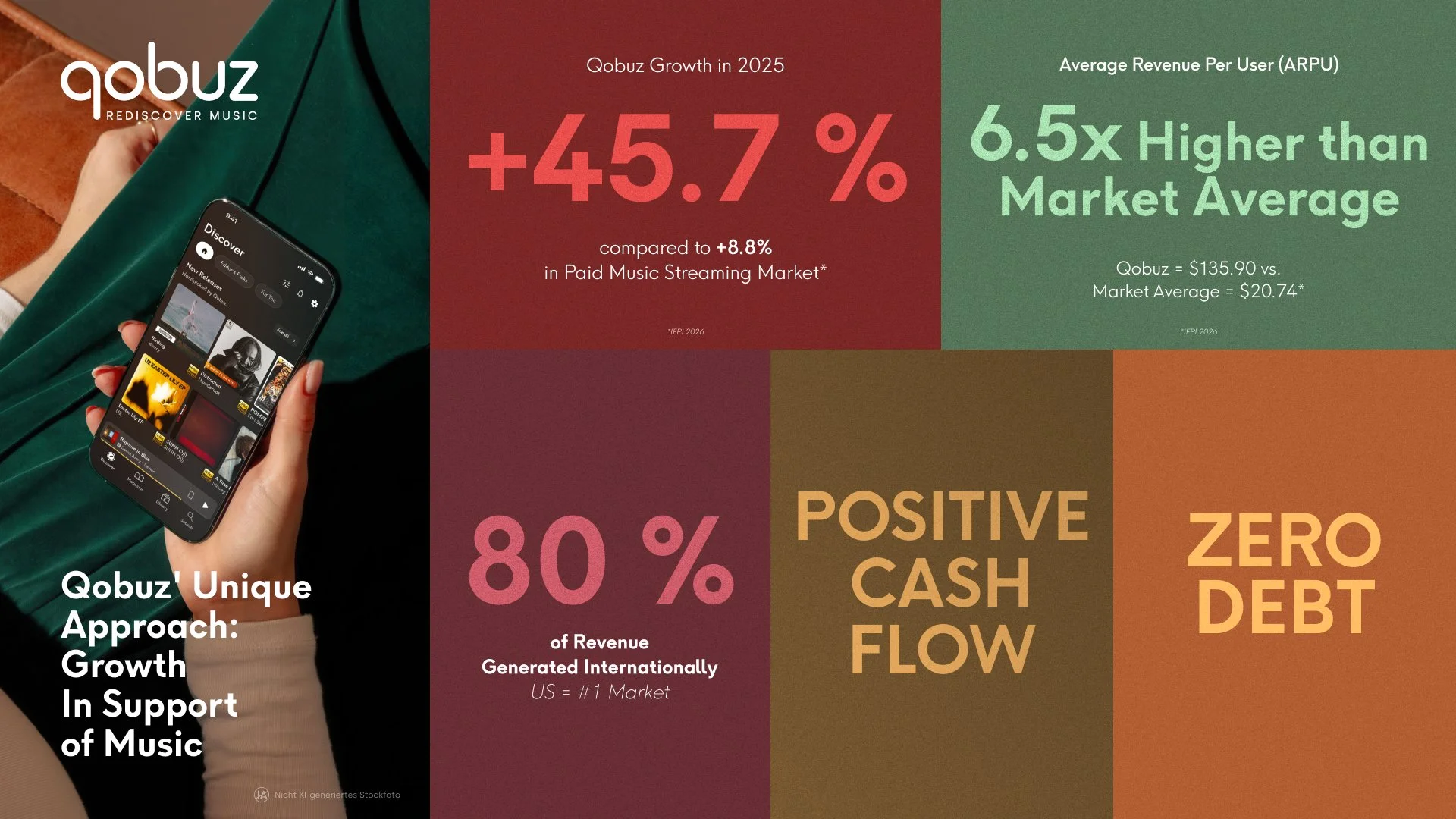
+45.7% growth in 2025 in a paid streaming market worth $16.6 billion, growing at +8.8%
80% of revenue generated from international markets, with the U.S. as Qobuz's #1 market
Average Revenue Per User (ARPU): more than 6.5x the market average — $135.90 vs. $20.74
Positive free cash flow and zero financial debt
A Growing Market, Driven by the Paid Model
In 2025, the global recorded music market reached $31.7 billion (1), with streaming accounting for 69.6% of total revenues and continuing to drive the sector's growth. Within streaming, the paid subscription model leads with +8.8% growth, concentrating value creation among engaged, paying listeners.
Positioned in the paid subscription segment from day one, Qobuz delivers +45.7% revenue growth in 2025 — more than five times the market rate, and now has 1.2 million monthly active users.
The Success Story of an Independent Company That Has Gone Global
Founded in 2007 and owned since 2015 by a private, primarily French family-owned group, Qobuz is today a global player.
An international business. 80% of revenue is generated from international markets. The United States is Qobuz's largest market, ahead of France. Present in 26 countries, including Japan since October 2024, the company continues its global expansion.
A clear path to profitability. Positive free cash flow, zero financial debt, EBITDA break-even reached under IFRS, and a positive net result expected by March 2027.
Revenue per user (ARPU) more than 6.5 times the market average. A Qobuz subscriber generates an average annual revenue of $135.90, compared to $20.74 for the market average (2).
These results confirm the strength of an independent model built on the quality of its offering and the engagement of its subscribers, rather than on volume.
"Since the acquisition in 2015, we have chosen a structured, coherent path forward: a differentiation strategy, disciplined execution, and fully committed teams. No dispersion, no public funding. This consistency is what is delivering strong, sustainable growth today," said Georges Fornay, Deputy CEO, Qobuz.
A Standout Player in a Market Dominated by Giants
In a sector dominated by major tech companies with considerable resources, Qobuz has built its position by staying true to its founding vision: respect for music, for the artists who create it, and for the people who listen to it.
This translates into structural choices that have been consistent since day one:
An exclusively paid subscription model, with no in-platform advertising
High-resolution audio quality, faithful to the original recording
The only platform combining streaming and à la carte Hi-Res downloads, in addition to editorial written by a team of journalists and music experts
100% human-curated selection, championing a diverse range of music and artists
An exception in the sector: 100% of employees are shareholders, sharing in the company’s success.
These choices have a direct, measurable impact on royalty payments within the music industry. In March 2025, Qobuz was the first and only streaming platform thus far to publicly disclose its average per-stream royalty rate, validated by a leading firm: $0.01873 per stream for fiscal year 2024 — equivalent to $18.73 per 1,000 streams paid to rights holders(3).
An Independent Platform Built for the Long Term
Qobuz is proof that companies with a genuine passion and clear vision for music, its creators, and its listeners have a real place in an industry where financial and industrial imperatives often take precedence.
"Our conviction has never changed: music at the heart of everything, by humans, for humans. That is what drives every decision at Qobuz, and our results show that this conviction is also a viable business model."
"Music streaming is a vast market. We have chosen to build our place within it on our own terms: premium, independent, in service of artists and music lovers. That journey is built to last," said Georges Fornay, Deputy CEO, Qobuz.
————
What Sets Qobuz Apart
CD Quality and Hi-Res Audio Across the Entire Catalog
All Qobuz subscriptions include access to uncompressed audio quality, including CD quality (16-bit/44.1 kHz), Hi-Res (24-bit/up to 192 kHz), and DSD / DXD formats for downloads. The Hi-Res audio format allows the truest possible reproduction of recorded music, allowing the full depth and each nuance to come through, respecting the intentions of artists. Qobuz offers the richest Hi-Res catalog on the market and is licensed by the Japan Audio Society (JAS), the leading authority on high-resolution audio standards.
Music Downloads: A Complementary Revenue Stream for Artists
Qobuz is one of the few platforms to offer digital music purchases in CD quality, Hi-Res, DSD and DXD formats. Unlike streaming, where revenue is pooled, downloads operate on a per-unit sales model - each purchase directly reflects the value of a specific work. Streaming and downloading are complementary: streaming drives discovery, while downloads generate stronger, more direct compensation for creators.
The AI Charter: Human Curation as a Safeguard Against AI-Generated Content
The drastic increase of AI-generated content poses a direct threat to artists and rights holders — diluted revenue, polluted catalogs, and the devaluation of music as an artform. Qobuz's AI Charter, published in February 2026, outlines how Qobuz approaches AI through three key areas:
100% human editorial selection: all featured recommendations are chosen by human teams.
Personalized recommendations that prioritize human artists: the Discover page draws exclusively on content curated by Qobuz' editorial team or trusted partners, excluding AI-generated tracks.
An AI content identification system: Qobuz has implemented proprietary tools to identify AI-generated content and detect fraudulent streaming patterns. Such content is excluded from royalty reporting and payments. AI-generated content is removed from the platform when issues are detected. It will also be clearly labelled and identified as such for users soon.
4. Royalty payments to rights holders: unprecedented transparency in streaming
In March 2025, Qobuz became the first and only music streaming platform so far to officially disclose its average per-stream royalty rate, confirmed by a leading independent auditing firm. For fiscal year 2024, Qobuz distributed royalties averaging $0.01873 per stream. Concretely, 1,000 plays on Qobuz generate an average of $18.73 paid to labels and publishers, who then compensate artists under the terms of their contracts (3).
5. Revenue Per User: More Than 6.5 Times the Market Average
ARPU — Average Revenue Per User — measures how much revenue a platform generates per user over a given period. For fiscal year 2025, Qobuz's ARPU stands at US$135.90, compared to a market average of US$20.74 (2). Qobuz generates more than 6.5 times more revenue per user than the sector average. This gap is the direct result of a 100% paid model: every Qobuz user is a paying subscriber, with no free accounts diluting the metric. A higher ARPU means a meaningfully greater impact on royalty payments across the music industry.
————
Sources:
1. IFPI Global Music Report 2026 (2025 data)
2. IFPI Global Music Report 2026 (2025 data) - ECB exchange rate: 1.13
3. Methodology: Over the 12-month period ending March 31, 2024, Qobuz recorded royalties owed to labels and publishers at an average of $0.01873 per stream. Royalty payment terms with labels and publishers are not always calculated on a per-stream basis and may vary by contract. Royalties reflect amounts recorded in Qobuz's financial statements as of March 31, 2024. Stream count reflects plays by Qobuz subscribers over the same period.
Note: Like all streaming platforms, Qobuz does not pay artists directly. Approximately 70% of revenues generated are paid to rights holders — collecting societies, distributors, aggregators, and labels — who in turn compensate artists, composers, and publishers under their respective agreements.